
Criminal Cases in the Gibson County Courts
Gibson County criminal cases move through more than one court. General Sessions handles misdemeanors within its authority, criminal and search warrants, bond matters, traffic cases, and the first steps in felony prosecutions. Felony cases may advance by indictment to Circuit/Criminal Court in Tennessee's Twenty-Eighth Judicial District. The Tennessee judiciary's General Sessions overview explains why this lower court is often the first file to check even when a felony case later receives a new trial-level docket.
The Circuit Court Clerk is the custodian for Gibson County Circuit and General Sessions files. Municipal clerks keep city matters within their authority. Milan and Humboldt are unusual because the official 2025 City of Milan v. Agee opinion recognizes concurrent General Sessions jurisdiction for qualifying cases within those cities. Bradford, Dyer, Gibson, Kenton, Medina, Milan, and Trenton also maintain municipal dockets, but none replaces the county felony court.
The official General Sessions Courts page shows the statewide court structure used in Gibson County.
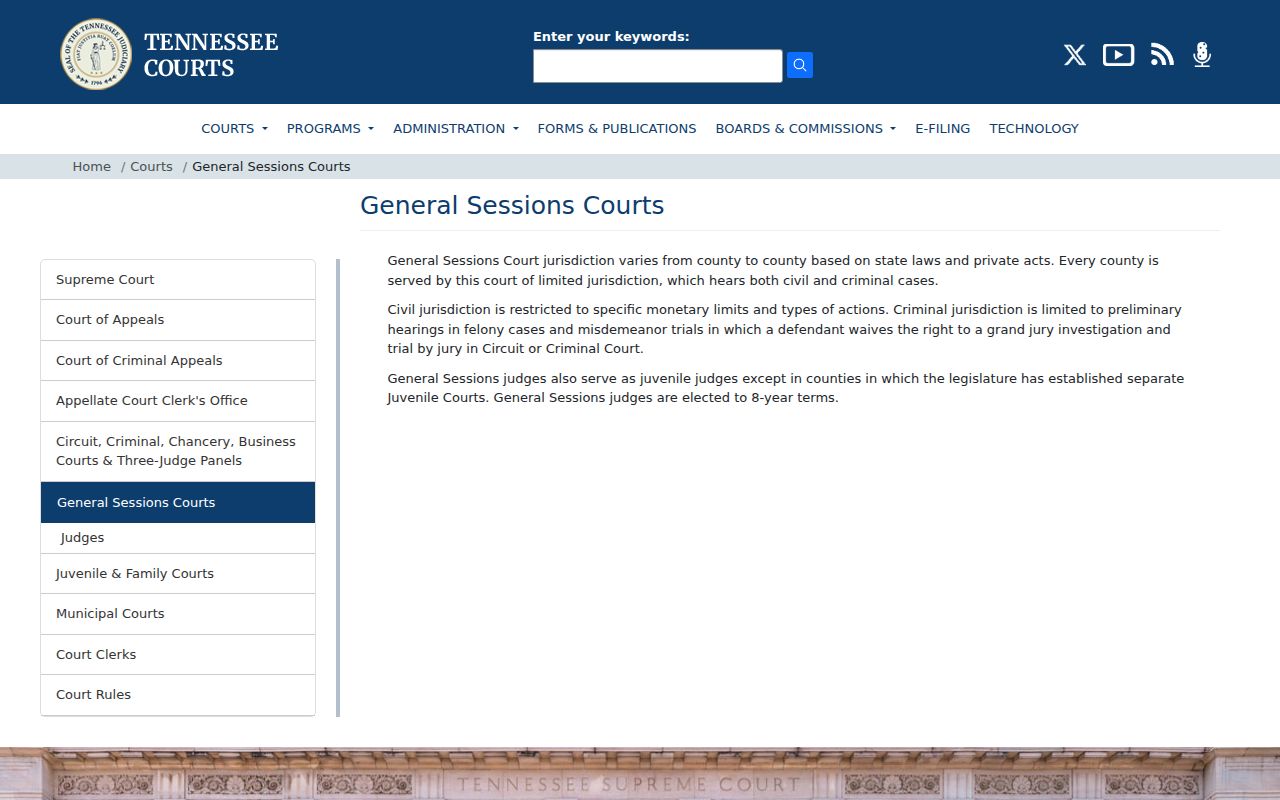
That division of work explains why the first docket can sit at General Sessions while the later felony trial record sits with Circuit/Criminal Court.
Gibson County Humboldt Case Labels
A notation such as “Gibson (H)” points to the Humboldt side of Gibson County's divided criminal-court geography. It is not another county and it does not describe a different offense class. Tennessee Administrative Office of the Courts statistics for fiscal year 2024-25 list 456 criminal filings under Gibson and 215 under Gibson (H), which confirms that both labels represent active filing venues.
This split can trip up a name search. A caller who asks only at Trenton may miss a Humboldt file, while a person who knows the case number can be routed with far less guesswork. Give the clerk the full name, approximate year, court level, and any docket or charge detail. Then ask whether the record is at 295 N. College Street in Trenton or 1421 Osborne Street in Humboldt.
How to Search Case Records
No official comprehensive Gibson County trial-court portal was found. The honest search path is a clerk-assisted lookup, followed by inspection or a copy request. A name and approximate year may start the search, but a case number is more dependable. Ask about both venues, whether an older file is archived, and whether a certified copy needs advance notice.
- Gather the defendant's full name, likely filing year, known charge, and any case number.
- Call the Circuit Court Clerk at (731) 855-7615 and ask which court level and venue hold the Gibson County case.
- For an early proceeding, call General Sessions in Trenton at (731) 855-7664 or Humboldt at (731) 784-9551.
- Ask whether inspection, a public terminal, email, mail, or an in-person copy is currently available.
- Request the current price for plain or certified records before ordering. No verified local criminal-copy schedule was published.
Because Gibson County has no public trial-search form, use this clerk-request field list instead of invented portal fields:
| Request Detail | Format | Priority | Why It Helps |
|---|---|---|---|
| Full party name | Text | Essential | Starts the clerk's index check |
| Case number | Text | Best identifier | Separates similar names |
| Filing or arrest year | Year | Strongly preferred | Narrows active and archived files |
| Venue | Trenton or Humboldt | Confirm with clerk | Locates the right docket |
| Copy type | Plain or certified | Required for order | Controls preparation and price |
Gibson County Court Level Guide
Start with General Sessions for a warrant, bond entry, misdemeanor, traffic charge, or early felony proceeding. Move to Circuit/Criminal Court when a felony is indicted or bound over for trial-level action. A municipal clerk is the better custodian for an ordinance or city-court traffic matter. The County Clerk at Court Square handles licenses, county-government minutes, and other administrative work, not the ordinary criminal case file.
The Tennessee Circuit and Criminal Courts overview supplies the statewide context for Gibson County's felony court.
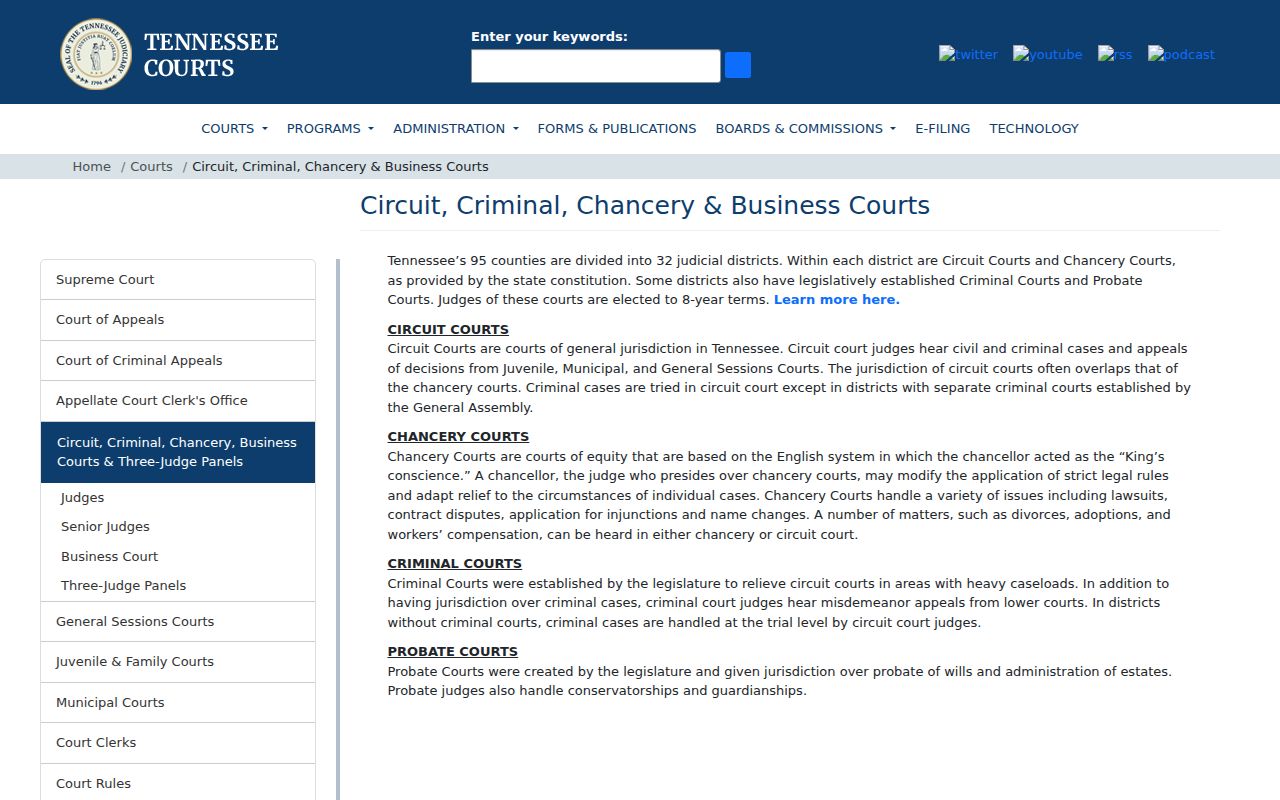
The key local distinction remains practical: the Justice Building and Humboldt venue hold criminal files, while the historic courthouse is not the main criminal-record counter.
What the Case File Shows
A Gibson County court file documents prosecution, not merely custody. It may show how the charge was filed, when the parties appeared, what motions or orders changed the case, and how each count ended. The docket is the chronological index. Read it with the charging paper, judgment, and sentence rather than relying on one isolated status line.
| Case Number & Court | Identifies the docket, court level, and Trenton or Humboldt venue. |
|---|---|
| Charging Document | Shows the complaint, information, or indictment and the counts filed in court. |
| Docket Entries | Lists dated filings, appearances, motions, orders, warrants, and case events. |
| Hearing Dates | Records scheduled proceedings and may note continuances or completed appearances. |
| Disposition & Judgment | Shows dismissal, nolle prosequi, acquittal, plea, verdict, or other result by count. |
| Sentence & Conditions | May state confinement, probation, costs, fines, restitution, and concurrent or consecutive terms. |
A booking charge can differ from the charge that the district attorney files. For that reason, the judgment and disposition in the Gibson County court file are the stronger sources for the final result. The separate Gibson County arrest history explains what the agency and jail records capture before prosecution is resolved.
Read Gibson County Case Dispositions
Short docket terms carry very different results. “Bound over” means the lower-court process advanced toward the grand jury or trial court. It is not a conviction. A retired case has not necessarily been dismissed, and a dismissal with costs may still need action before an expungement request can proceed.
- Nolle prosequi
- The prosecutor formally declines to continue that charge at that time.
- No true bill
- The grand jury declines to return an indictment.
- Disposition
- The recorded outcome of one charge, which may differ across counts.
- Judicial diversion
- A qualifying plea is deferred, with possible dismissal and expungement after successful completion.
- Capias
- An order to take a person into custody, often tied to a missed appearance or violation.
Ask the Gibson County clerk for the judgment or signed order when a docket abbreviation is unclear. A single word in an index may not show the conditions, count-by-count outcome, or later order.
Stages of a Criminal Case
Many Gibson County felony matters begin in General Sessions with a warrant, bond decision, and preliminary process. The prosecutor may alter or decline charges. If a grand jury returns an indictment, Circuit/Criminal Court takes the trial-level case through arraignment, motions, plea talks, trial, judgment, and sentence. An appeal then creates a separate record in the Court of Criminal Appeals.
Case flow: Charges Filed › Arraignment › Pretrial › Plea or Trial › Disposition › Sentencing
Dates vary with the docket and facts, so the clerk's current entries control. The Tennessee Public Case History tool can help after an appeal begins, but it is appellate-only and cannot stand in for a Gibson County trial file.
Gibson County Criminal Appeal Records
An appeal creates a new record layer rather than moving the entire Gibson County trial file online. Tennessee Public Case History may show an appellate case number and style, trial court and judge, trial number, party roles, dated events, permitted PDF filings, bond information, and the size of the record sent up. It cannot locate every General Sessions or Circuit case that never reached an appellate court.
Begin with the local judgment and notice of appeal, then use the appellate number for later events. If the question concerns a motion, exhibit, or sentencing term from the trial, ask the Gibson County clerk for that underlying item. The appellate index is best for tracking review, opinions, and mandates, not for replacing the original docket.
Gibson County Criminal Recovery Docket
Gibson County Recovery Court is a named specialty docket for the Twenty-Eighth Judicial District. Tennessee's official recovery court contact list places it in the 295 N. College Street area and identifies General Sessions Judge Bradley Owens and contact Angelia Duck at (731) 487-6749. The program does not replace the ordinary clerk file. Court orders, conditions, compliance events filed with the court, and the ultimate disposition remain part of the appropriate case record.
When a docket mentions recovery court, ask the clerk which case number carries the operative orders and where the public portion can be inspected. Treatment, health, juvenile, and other protected details may be sealed or redacted even when the existence of a public proceeding can be confirmed.
Gibson County Circuit Court Clerk
295 N. College St.
Trenton, TN 38382
(731) 855-7615
Monday-Friday, 8:00 a.m.-4:00 p.m.
Access & Restrictions
Tennessee Supreme Court Rule 34 governs public access to court records while protecting confidential data. Gibson County files may omit or redact juvenile information, victim and minor identifiers, Social Security and account data, medical details, sealed filings, and records covered by an expungement order. A missing public result is not proof that no proceeding ever existed.
The Tennessee Public Records Act also supports access to government records, but court-file rules and specific confidentiality laws still apply. Make a focused request. Give the case number, date range, court, venue, document type, and whether inspection or a copy is sought. If the clerk cannot disclose an item, ask which rule or order controls and whether a redacted version is available.
Note: Public access does not override a sealing order, an expungement, or laws that protect juvenile and victim information.